
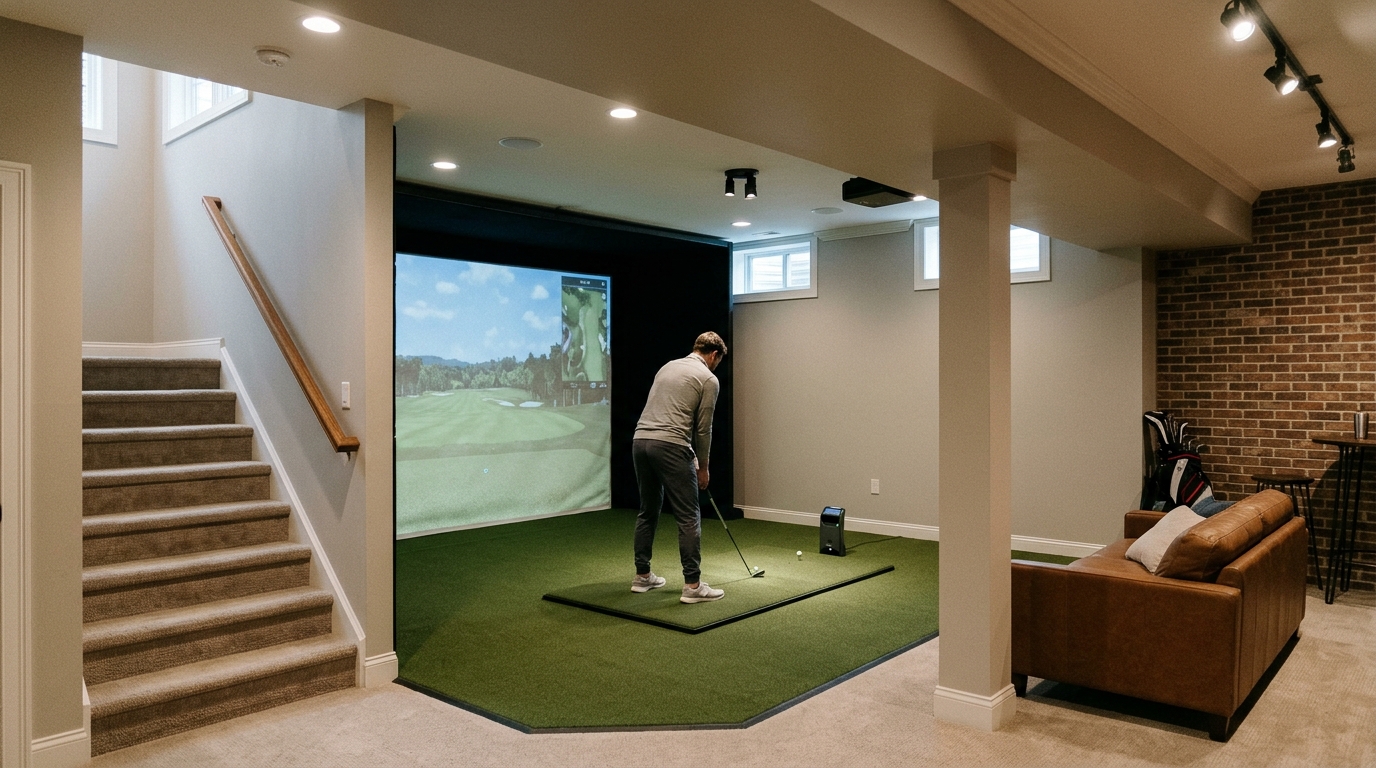
Choosing the right tracking technology is the most critical decision when building an indoor golf studio. Basement environments present unique challenges, including low ceilings and limited space, which require specific hardware capabilities. Turnkey Pro Studios specializes in matching these technical requirements to your specific room dimensions to ensure accurate data capture.
1. Ceiling Height Compatibility
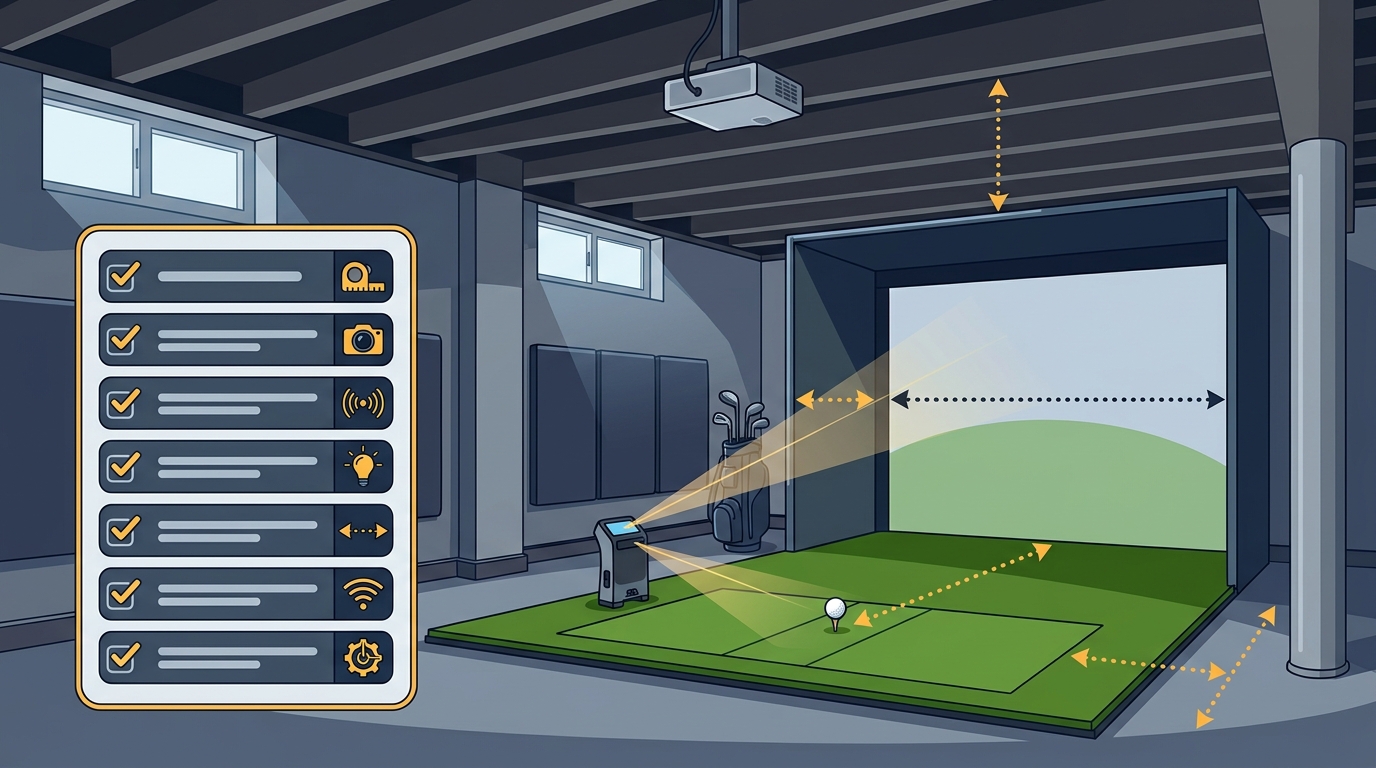
Verify the minimum clearance required for your specific monitor model. Many standard launch monitors require a minimum ceiling height of 9 to 10 feet to capture full swing data. If your basement has 8-foot ceilings, you must select a short-throw or low-ceiling compatible unit. This ensures the optical sensors can track the ball without obstruction from the roof structure.
2. Room Depth and Width Constraints
Measure the distance from the hitting mat to the screen to determine throw length. A standard full-length simulator requires 18 to 20 feet of depth. For smaller basements, a short-throw setup allows for a 12 to 15-foot depth. You must confirm that the launch monitor you choose supports the specific throw length of your room to maintain calibration accuracy.
3. Optical Tracking vs. Doppler Radar
Understand the difference between camera-based and radar-based tracking systems. Optical tracking uses high-speed cameras to record ball flight, while Doppler radar uses radio waves to measure speed and spin. Optical systems often provide more detailed club face data, whereas radar systems can be less affected by lighting conditions. Choose the technology that aligns with your primary practice goals.
4. Lighting and Ambient Light Tolerance
Assess how the monitor performs in low-light or variable lighting environments. Basements often lack natural light, which can affect camera-based launch monitors. Some systems require specific lighting setups or dark rooms to function correctly. Ensure the unit you select is rated for the ambient light levels present in your specific basement space.
5. Data Accuracy and Metrics Offered
Identify the specific ball and club metrics you need for your game improvement. A launch monitor is a device that measures the physics of a golf shot, including ball speed, launch angle, and spin rate. Different models offer varying levels of precision and different data sets. Prioritize a unit that provides the specific metrics relevant to your swing analysis and coaching needs.
6. Software Ecosystem and Compatibility
7. Installation Complexity and Mounting Options
Consider the ease of installation and the available mounting configurations. Some launch monitors require complex ceiling mounts, while others can be placed on a tripod or a dedicated stand. For a basement setup, a stable, non-invasive mounting solution is often preferred to avoid drilling into concrete or structural beams. Check the manufacturer's installation requirements against your room's structural layout.
Choosing the Right Fit
Select the launch monitor that best matches your room's physical dimensions and your specific data requirements. If you are unsure which technology fits your space, contact our team for a tailored recommendation based on your basement measurements.
Frequently Asked Questions
What is the minimum ceiling height for a golf simulator?
Most standard golf simulators require a minimum ceiling height of 9 feet. However, short-throw setups can operate in rooms with ceilings as low as 8 feet, provided the correct launch monitor and screen configuration are used.
Can I use a launch monitor in a basement with no windows?
Yes, many launch monitors are designed to work in low-light or dark environments. You should verify the specific lighting requirements of the model you choose, as some optical systems may require a certain level of ambient light or a specific dark room setup.
What is the difference between a launch monitor and a simulator?
Do I need a specific type of screen for a basement simulator?
You need a screen that matches the throw length of your launch monitor. For basements with limited depth, a short-throw screen is required. The screen size and material should also be compatible with the impact force of your swings to ensure durability and accuracy.
How does Turnkey Pro Studios help with basement installations?
Turnkey Pro Studios provides expert guidance on room dimensions and equipment compatibility. We help you select the right launch monitor and enclosure for your specific space, ensuring a seamless installation process from start to finish.